- What scratch and dent actually means
- What you actually save
- The warranty question, which decides everything
- Where the damage comes from
- What to check before you pay
- Scratch and dent vs used vs refurbished
- The costs nobody lists
- When it is the right call
- The honest comparison with renting
- Common questions
What scratch and dent actually means
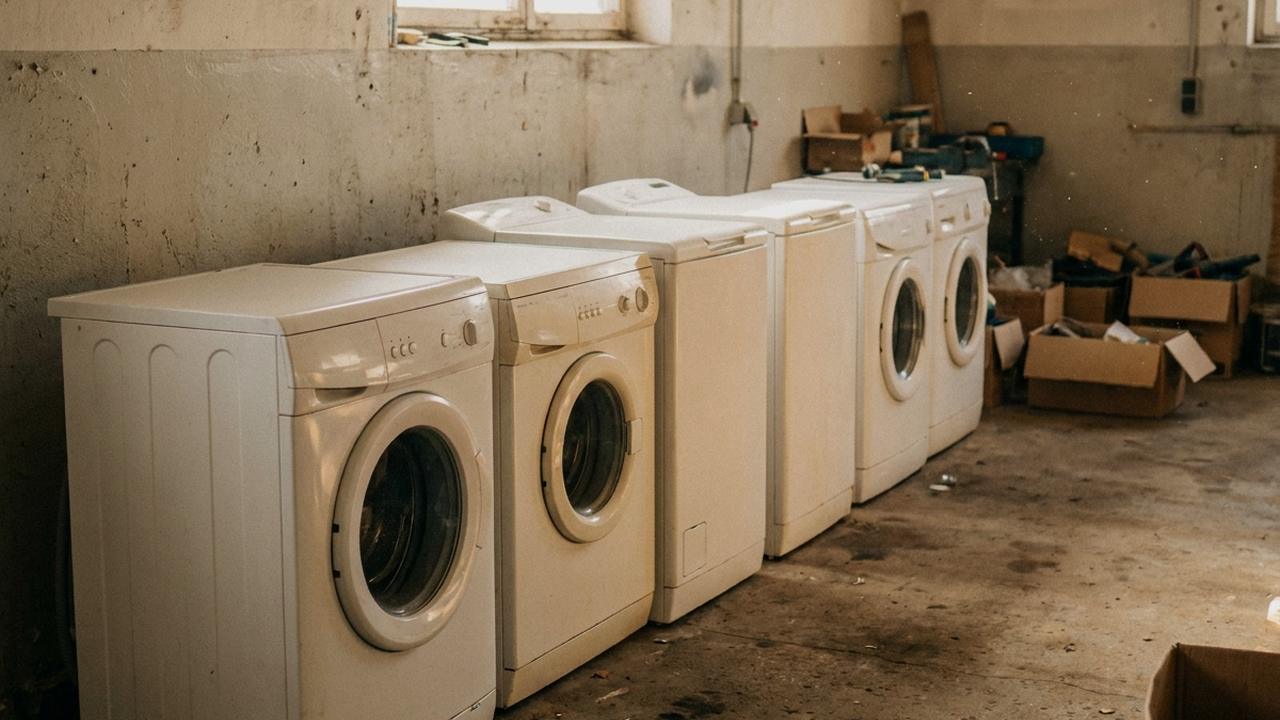
A scratch and dent appliance is a brand new machine that has never been used, carrying cosmetic damage. The drum has never turned a load. The motor has never run outside a factory test. Someone dropped, scraped or dinged the outside of the cabinet somewhere between the production line and the showroom floor, and that mark disqualifies it from being sold as new.
This is the part people get wrong, and it is worth being precise about, because the entire value of the category rests on it. Scratch and dent is not used. It is not refurbished. It is not a machine that broke and got fixed. The mechanical life of the appliance is completely untouched. You are buying a full-life machine and taking a discount for a flaw in the metal.
Whether that is a bargain or a trap comes down almost entirely to one thing, and it is not the size of the dent.
What you actually save
Expect 20 to 50 percent off the normal retail price. The spread is wide because it tracks how visible the damage is, how current the model is, and how badly the seller wants the floor space back.
| Where the damage is | Typical discount | Worth taking? |
|---|---|---|
| Side panel | 25% to 50% | The best value in the category. Most washers and dryers sit against a wall or between cabinets, so the flaw disappears the moment it is installed. |
| Rear panel or top | 30% to 50% | Excellent, unless you are stacking or the top doubles as a work surface. Nobody ever sees the back of a machine again. |
| Front panel or door | 15% to 30% | Smaller discount and you look at it every day for a decade. Only worth it if the price cut is genuinely steep. |
| Around the controls | Varies | Be careful. Cosmetic damage next to the control panel can sit alongside something structural, and a control board is one of the expensive repairs. |
| Box only, machine clean | 10% to 20% | The cheapest discount for a seller to give. Fine, but verify the machine itself really is unmarked. |
The arithmetic that matters: on an $1,100 washer and dryer pair, a genuine 35 percent off is $385 saved for a mark on a panel that ends up facing drywall. That is a real saving on a machine with its full service life ahead of it, which is not something the used market can offer at any price.
The warranty question, which decides everything
This is the most important paragraph on this page.
Ask directly: does this carry the full manufacturer warranty, and will you put that on the receipt?
The answer splits this market cleanly in two, and the two halves look identical standing on a showroom floor.
- Authorised dealers selling scratch and dent stock can usually register the machine normally, and it carries the same manufacturer warranty a perfect one would. The appliance is new and unused, so there is nothing for the manufacturer to object to. This is the version worth buying, and it is genuinely one of the best deals in appliances.
- Liquidators, clearance outlets and auction lots often sell as-is, with a 30 to 90 day store warranty at best and frequently nothing at all. The machine is still new and still unused, but if it arrives dead you have no manufacturer to call and usually no return path either.
Both are legitimate businesses. The problem is that the second kind is often priced as though it were the first. Forty percent off a fully warranted new machine is an excellent deal. The same forty percent on a machine with no coverage and no returns is a different transaction, and it ought to cost less than that, not the same.
Get the answer in writing. A seller who really is an authorised dealer will not hesitate, because confirming it costs them nothing. The hesitation is the answer.
Where the damage comes from
Knowing the source tells you how much to worry, and mostly the answer is not much.
- Freight and warehouse handling. The largest source by far. A forklift tine catches a corner, a pallet shifts in a trailer, a strap bites into a panel. The machine inside is untouched.
- Floor models. Plugged in and demonstrated, occasionally with a scuffed door or worn control markings, but never run through a real cycle with water and clothes in it.
- Open box returns. Someone bought it, opened it, and sent it back, often because it did not fit or they changed their mind. It legally cannot be resold as new.
- Discontinued and overstock. Frequently no damage at all, just last year's model number taking up space somebody needs.
- Insurance and salvage lots. The one to be careful with. Stock recovered from a wrecked truck or a flooded warehouse may have taken water or impact you cannot see. Ask what happened, and grow more suspicious as the discount deepens.
What to check before you pay
Less checking than a used machine needs, because there is no wear to assess. But do not skip it: the whole premise is that the damage is only cosmetic, and that premise is worth verifying yourself.
- Plug it in and run it if you possibly can. Even a short cycle. A dealer with real stock and real confidence will usually allow it. On an as-is sale with no warranty, a refusal to demonstrate the machine should end the conversation.
- Open the door and turn the drum by hand. It should spin freely and quietly. Grinding or resistance on a machine that has never been used means it took an impact somewhere that matters.
- Check the damage is only skin deep. Press near the dent. If the panel flexes into a gap that should not be there, something behind it moved. A dent that has pushed the drum out of alignment is not a cosmetic dent, whatever the tag says.
- Look at the door seal on a front loader. The gasket must sit flat and unbroken all the way round. A distorted door frame is the one cosmetic-looking fault that reliably causes leaks.
- Confirm it really is new. Ask for the model and serial number and check the machine has not already been registered. Refurbished stock sometimes sits alongside scratch and dent, and the two get blurred in conversation more often than by accident.
- Get the exact warranty terms on the receipt, not in conversation. This is the check that matters most.
- Ask about delivery, installation and haul-away separately, before you agree a price. Clearance sellers frequently include none of them.
Scratch and dent vs used vs refurbished
| Scratch and dent | Refurbished | Used | |
|---|---|---|---|
| Ever used? | No | Yes, then repaired | Yes |
| Life remaining | Full | Partial | Unknown |
| Typical warranty | Full manufacturer, if an authorised dealer | 30 to 90 days, from the shop | None |
| Typical set price | $700 to $1,100 | $400 to $700 | $100 to $400 |
| Main risk | An as-is sale with no coverage | Quality of the repair | Everything |
The honest read: scratch and dent costs the most of the three and is usually the best value of the three, provided the warranty is real. You pay near-new money for a near-new machine and get the full service life. Used costs a third as much and gives you an unknown fraction of the life remaining. There is a fuller breakdown of that side in our guide to buying a used washer and dryer.
The costs nobody lists
Clearance pricing is often quoted the way airlines quote fares. The number on the tag is the beginning of the number.
- Delivery: $60 to $150. Full-price retailers frequently include it. Clearance outlets frequently do not.
- Installation: $50 to $150, more if a dryer vent or a gas line is involved.
- Stairs: $25 to $75 a flight. A washer is around 200 pounds and does not fit in a car.
- Hauling the old set away: $40 to $100. Almost never included on a clearance sale.
- New supply hoses: $15 to $40. Always replace them. A burst hose is one of the most common causes of serious water damage in a home.
- Dryer cord: $20 to $40. Electric dryers take a three-prong or four-prong cord and your outlet is one or the other. Cords are usually sold separately.
So a $780 scratch and dent pair, with delivery, installation, a cord and hoses, is closer to $950 to $1,050 sitting in your laundry room. Still a real saving against $1,200 retail. Just a different number from the one on the tag.
When it is the right call
Buy scratch and dent when the machine is going into a laundry closet, a garage or an alcove where only the front is visible, the damage is anywhere but the front, the seller is an authorised dealer who will confirm manufacturer coverage in writing, and you plan to stay put long enough for a full-life machine to pay off. Under those conditions it is arguably the best value in the entire appliance market.
Think harder when the sale is as-is with no warranty and no returns, the discount is under about 20 percent, the damage is on a surface you will look at daily, the stock came out of a salvage or flood lot, or you are renting your home and might move within the year. In that last case you are buying a 200-pound object you will have to move, sell or dispose of well before the machine's life justifies it.
The honest comparison with renting
We run a directory of independent washer and dryer rental operators, so treat the arithmetic below as something to check rather than something to trust. Every assumption is shown.
Say a scratch and dent pair lands at $950 all in, delivered and installed. The national going rate to rent a full set is $40 to $60 a month with delivery, installation and every repair included.
- At 6 months: $950 bought, against about $300 rented. Renting is well ahead.
- At 12 months: $950 against about $600. Renting is still ahead.
- At 18 months: $950 against about $900. This is roughly the crossover.
- At 3 years: $950 against about $1,800. Buying is clearly ahead, and pulling further away every month.
It flips at around eighteen months, later than the crossover for a used set because the purchase price is higher. If you will be in the same home for two years or more and you have the cash today, buying scratch and dent wins on pure cost and it is not close. If you are inside a year and a half, moving soon, or the cash matters more right now than the total does, renting usually costs less.
The other half of it is what happens when something fails. On a machine bought with a real manufacturer warranty, that is a phone call and some waiting. On an as-is clearance machine with no coverage, it is your problem and your money. On a rented set it is the operator's problem by contract. Which of those you prefer is a genuine matter of temperament and cash flow, not a question with one right answer.
If you want to see what renting costs where you live, you can search by ZIP code to see the operators who actually cover you, or work out your own number against what you are spending now.
Common questions
Are scratch and dent appliances covered by the manufacturer warranty?
Sometimes, and it is the first thing to establish. A unit from an authorised dealer usually carries the full manufacturer warranty, because the machine is new and unused. A unit from a liquidator or clearance outlet is frequently sold as-is with a short store warranty or none at all. Ask directly, and ask for it on the receipt.
How much do you actually save on scratch and dent appliances?
Typically 20 to 50 percent off retail, tracking how visible the damage is. A deep dent on a side panel that will face a wall is where the value sits: the discount is real and the flaw is invisible once installed. Front panel and door damage discounts less and you see it every day.
What is the difference between scratch and dent, refurbished, and used?
Scratch and dent is brand new and never used, with cosmetic damage from shipping or handling. Refurbished has been used, returned, then repaired and tested, usually with a short warranty. Used is second hand and sold as it stands. Scratch and dent is the only one of the three where the mechanical life of the machine is completely untouched.
Where does scratch and dent stock come from?
Mostly freight and warehouse damage, plus floor models, open box returns and discontinued lines. A forklift catches a corner or a pallet shifts in a truck. None of that affects how the machine works. Salvage and flood lots are the exception and are worth asking about.
Can you return a scratch and dent appliance if it does not work?
Usually not. Most clearance sales are final, which is exactly why the warranty question matters so much. If the manufacturer warranty applies you have a repair path even without a return path. If it does not, a dead machine is your problem.
Is scratch and dent worth it for a washer and dryer specifically?
It is one of the better categories for it. Washers and dryers are large, boxy and usually installed against a wall or in a closet, so the damaged panel is very often the one nobody sees. A refrigerator, by contrast, is far more likely to carry its damage on a door you look at every day.
Can I rent a washer and dryer instead of buying one?
Yes. Independent operators in most metro areas rent a full set for a flat monthly rate with delivery, installation and repairs included, usually with no credit check and no deposit. It is a straight rental rather than rent to own, so you never carry a balance and you can hand it back.