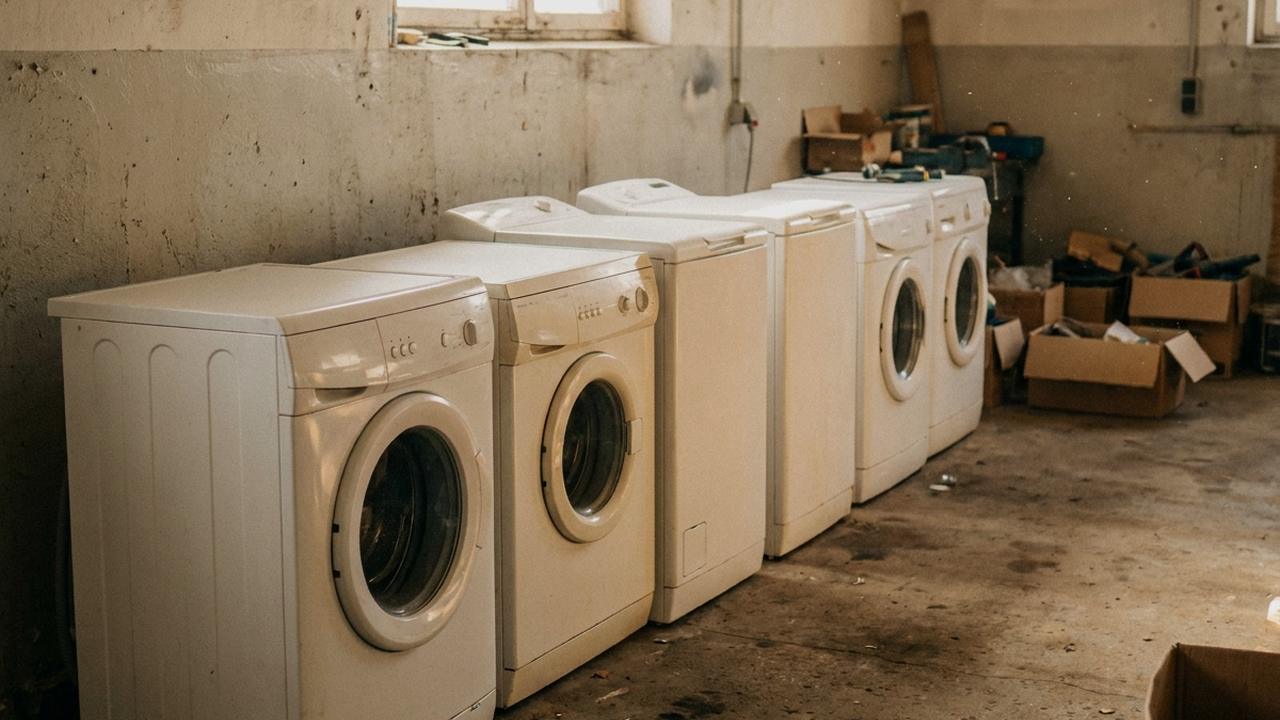
What a used washer and dryer actually costs
Prices vary by region, but across the country a used set generally lands in these bands. Anything meaningfully below the low end usually means the seller knows something you don't.
| Condition | Set price | What you are getting |
|---|---|---|
| As-is, untested | $100 to $200 | Marketplace, estate sale, "worked when removed." No recourse. Budget for a repair immediately. |
| Tested, older | $250 to $400 | Ten to fifteen years old, cleaned, run through a cycle. The most common honest listing. |
| Reconditioned by a shop | $400 to $700 | Parts replaced, usually a 30 to 90 day warranty. The safest way to buy used. |
| Scratch and dent, new | $700 to $1,100 | Cosmetic damage only, full manufacturer warranty. Often the best value in the whole market. |
| New, entry level | $900 to $1,400 | Plus delivery, plus haul-away, plus cords and hoses. |
Most underrated option: scratch and dent. A dented side panel that faces a wall costs you nothing and takes hundreds off a machine that still carries its full factory warranty. If you have an appliance outlet within driving distance, look there before you look at ten-year-old machines on Marketplace.
The 9-point check before you hand over money
Do not buy a machine you have not seen running. That one rule prevents most bad outcomes. If a seller will not plug it in, walk away regardless of the price.
- Run a full cycle, not a demonstration.Fill, agitate, drain, spin. A machine can fill beautifully and fail on the spin, which is the expensive repair. Sitting through one short cycle is fifteen minutes that can save you $300.
- Listen during the spin.Grinding or a deep rumble usually means bearings, and on most machines a bearing job costs more than the machine is worth. Walk away. A rhythmic thump is often just an unbalanced load, which is nothing.
- Look underneath and behind.Rust on the base pan, water stains, or a crusty white residue means it has been leaking. Lift the lid and check the underside of the top panel for rust too.
- Check the drum for movement.Grab the drum and pull it toward you, then push it back. More than slight play means worn bearings or a worn drum support.
- Smell the washer.A sour, mildewy smell in a front loader means the door gasket has been neglected. Sometimes it cleans up. Often it does not, and it will make your clothes smell.
- On the dryer, feel the airflow.Run it on high for two minutes and put your hand at the exhaust. Weak airflow with a hot drum points to a blower or a duct problem. Also check that it actually gets hot, because a dryer that tumbles but does not heat is a very common and very useless machine.
- Check the cord and the plug.Electric dryers come with 3-prong or 4-prong cords and your outlet is one or the other. It is a cheap swap if you know in advance and an aborted install if you do not. Gas dryers need a gas hookup, which is a different job entirely.
- Find the model and serial number and look up the age.It is usually on a sticker inside the door frame or on the back. Most manufacturers encode the year in the serial. A fifteen-year-old machine is not automatically bad, but it changes what it is worth.
- Ask what is wrong with it.Open-ended, straight to the seller's face. Honest sellers will tell you the lid switch is finicky or it needs a new hose. How long they take to answer tells you as much as the answer.
Two things that should end the conversation. A seller who will not let you run it, and any front loader with a bad bearing noise. Both are how people end up paying $250 for scrap metal they now have to get rid of.
Common questions
How many years does a used washer and dryer last?
A washer typically lasts 10 to 13 years in total and a dryer 10 to 15, so a well-maintained eight-year-old machine may still have several years in it. Age matters less than how it was treated. A ten-year-old machine from a two-person household will usually outlast a five-year-old machine that ran four loads a day.
What is a fair price for a used washer and dryer set?
$250 to $400 for a tested older set, $400 to $700 reconditioned from a shop with a short warranty, and $100 to $200 for anything sold as-is and untested. Below $100 for a working set usually means it is not a working set.
Is it worth buying a used washing machine?
Usually yes, if you can inspect it properly and you are staying put. The cost per year of a $400 set that runs for five years is very hard to beat. It becomes a bad deal when you cannot test it first, cannot move it, or will not be living there long enough to earn back the outlay.
What should I check before buying a used dryer?
That it heats, not just that it tumbles. Run it hot for two minutes and feel the exhaust for strong, hot airflow. Then confirm your hookup type: gas dryers need a gas line, and electric dryers come with 3-prong or 4-prong cords that must match your outlet.
Is renting cheaper than buying a used washer and dryer?
For roughly the first year, yes, because there is no upfront outlay and repairs are included. After about a year the bought set pulls ahead, and by year three it is clearly cheaper.
The break-even depends heavily on whether the used machine needs repairs, which is the part nobody can predict.
Can I rent a washer and dryer instead of buying one?
Yes, and it is more available than most people realise. Independent operators in most metro areas rent a full set for a flat monthly rate with delivery, installation and repairs included, generally without a credit check or a deposit. It is a straight rental, not rent to own, so you never carry a balance.
Should I repair my old washer or replace it?
The common rule is that if the repair costs more than half the price of replacing the machine, replace it. Bearings and control boards usually fail that test. Pumps, belts, lid switches, hoses and heating elements usually pass it comfortably and are worth fixing.
Where to buy, ranked by risk
Used appliance shops
The lowest-risk way to buy used. They test what they sell, they usually offer 30 to 90 days of warranty, and many will deliver and install. You pay more than Marketplace and you are buying peace of mind with the difference. If you are not comfortable diagnosing a machine yourself, this is the right choice.
Scratch and dent outlets
New machines with cosmetic damage, full warranty, often 30 to 40 percent off. The catch is inventory: you get what they have, so you may not get a matched set. Worth a phone call before anything else on this list.
Facebook Marketplace and Craigslist
The cheapest prices and all of the risk. Everything in the nine-point check above exists because of this channel. There are genuinely good machines here, sold by people moving house who want them gone this weekend, and there are also machines being quietly offloaded because they are broken. You are the quality control.
Estate sales and auctions
Occasionally excellent, usually untested, and almost always your problem to move. Only worth it if you can assess a machine quickly and you have a truck.
The costs nobody puts in the listing
The sticker price is rarely the real price. Budget for these before you decide a used set is cheaper than the alternatives.
| Item | Typical | Notes |
|---|---|---|
| Getting it home | $60 to $150 | Truck rental or a mover. A washer is roughly 200 lbs and does not fit in a car. |
| Getting it up stairs | $25 to $75 per flight | Or one friend and a real chance of injury. |
| New hoses | $15 to $40 | Always replace them. A burst supply hose is the single most common cause of catastrophic water damage in a home. |
| Dryer cord | $20 to $35 | If the prong count does not match your outlet. |
| Vent kit | $15 to $120 | More if a vent needs installing at all. |
| First repair | $150 to $350 | On an untested machine, assume this is when, not if. |
| Disposal at the end | $40 to $100 | Or you sell it on, which is its own weekend. |
A $250 Marketplace set with a $100 truck rental, $40 of hoses, and one $200 repair in the first year is a $590 set. That is still often a good deal. It is just a different number from the one in the ad.
When buying used is right, and when it isn't
Buy used when: you are staying put for several years, you have a truck or a friend with one, you can do a basic repair or you know somebody who can, and you have the cash today. Under those conditions a well-chosen used set is the cheapest laundry you will ever do.
Think harder when: you are renting and may move within a year or two, you have no way to move 200 lbs up a staircase, an unexpected $300 repair would genuinely hurt, or you are in a hurry because you are currently doing laundry at a laundromat. Those are the situations where the sticker price and the real cost diverge the most.
The honest comparison with renting
We run a directory of washer and dryer rental operators, so treat this section with the appropriate suspicion and check the arithmetic yourself. We have tried to make it easy to check.
Renting a full set from an independent operator generally runs $40 to $60 a month, which usually includes delivery, installation, and all repairs for as long as you rent. Here is how that stacks up against a $400 used set over time.
| After | Used set, bought | Rented at $50/mo | Who is ahead |
|---|---|---|---|
| 6 months | ~$540 | $300 | Renting |
| 1 year | ~$540 | $600 | About even |
| 2 years | ~$740 | $1,200 | Buying |
| 4 years | ~$1,090 | $2,400 | Buying, clearly |
Bought column assumes $400 purchase, $100 transport, $40 hoses, and one repair in year two and another in year four. Rented column assumes no deposit and repairs included, which is the norm but worth confirming with your operator.
So the honest answer is that it flips at roughly a year. If you know you will be in the same place for three years or more and you can handle a repair, buying used wins on cost by a wide margin. If you are inside a year, moving soon, or you cannot absorb a surprise repair bill, renting usually costs less and always costs less stress.
The other thing worth weighing is what happens when it breaks, because eventually it will. On a machine you bought, that is your problem, your Saturday, and your $250. On a rented machine it is a phone call. Some people would happily pay a few hundred dollars a year to never think about it again, and some people would rather keep the money and fix it themselves. Both are reasonable positions.
Want to see what renting costs where you live?
Search your ZIP and see the operators covering your area, with their real prices and terms. Free, and there is nothing to sign up for.
Find operators near me